
Aotearoa Freightline Review: The Timetable is the Real Terrain
In the world of logistics simulators, there is a fine line between satisfying complexity and overwhelming bureaucracy. Aotearoa Freightline, the latest PC strategy title from a dedicated team of transport enthusiasts, manages to walk that tightrope with impressive grace. This is a game where the landscape itself is your greatest adversary, and where mastering the intricacies of rail networks feels like solving a massive, interconnected puzzle. From the moment you lay your first stretch of track to the late-game orchestration of multi-modal freight empires, the game demands a rigorous understanding of physics, timing, and strategic planning.
At the heart of the experience is an intricate system of contract chains. You do not simply move a generic box from point A to point B. Instead, you are tasked with managing the entire lifecycle of goods. A typical early-game scenario might involve transporting raw timber from a high-country forestry block down to a coastal mill, then shifting the processed lumber to a bustling port for export. These contracts are woven into a dynamic economy where supply and demand fluctuate based on your efficiency. Fulfilling these chains requires not just route planning, but a keen awareness of your rolling stock's capabilities and the specific demands of each cargo type.
Mastering the Interchange
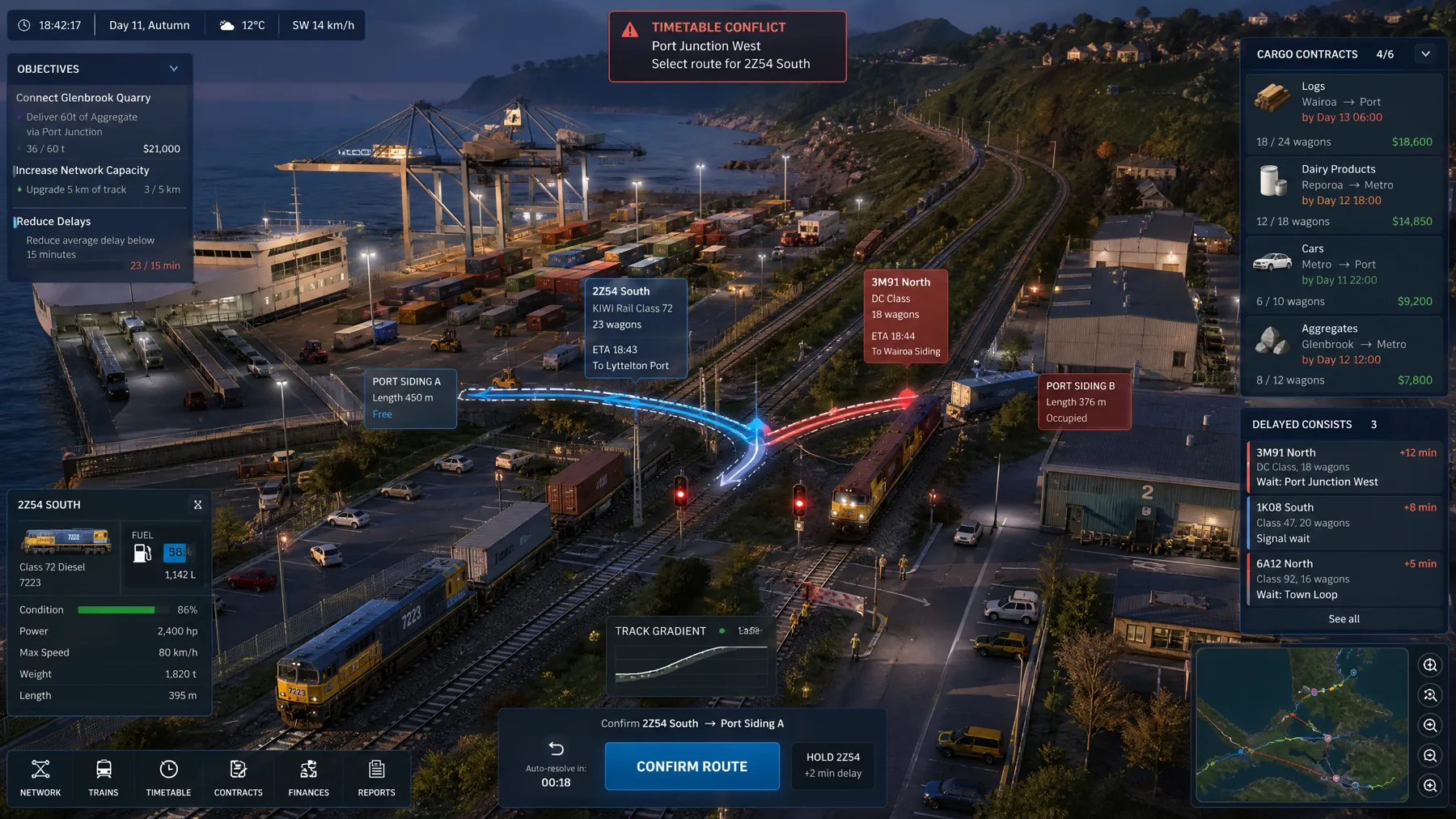
The visual representation of these logistics hubs is nothing short of mesmerising. Zooming in on a major port interchange reveals a bustling isometric diorama of industry. You can watch as freight trains pull into sidings, their loads deftly transferred by towering cranes onto waiting cargo ships or inter-island ferries. The interface overlays this activity with crisp route arrows, fuel indicators, and looming contract deadlines, providing a wealth of information at a single glance. It is a beautiful, mechanised ballet, provided you have set up your schedules correctly. When you have not, it is a spectacular, albeit frustrating, traffic jam.
What truly sets Aotearoa Freightline apart from its peers is its uncompromising approach to gradient physics. The topography of New Zealand is famously rugged, and the game translates this into a core gameplay mechanic. Laying track straight up a hillside is a recipe for disaster. Your locomotives will struggle, burn through fuel at an alarming rate, and potentially stall, backing up your entire network. Instead, you must carefully carve switchbacks into the mountainsides, construct costly tunnels, or utilise specialised banking engines to push heavy loads up steep inclines. The momentum of a fully loaded coal train heading down a steep grade is equally terrifying, requiring careful management of braking systems to avoid catastrophic derailments.
Signals and Schedules
Managing the flow of traffic across this challenging terrain brings us to the game's signalling system. It is a robust, logic-based network that will test your spatial reasoning. You must implement block signals, path signals, and complex junctions to ensure that multiple trains can share the same mainlines without colliding or deadlocking. The learning curve here is steep, but the satisfaction of watching a half-dozen trains seamlessly weave through a complex interchange without stopping is immense. The game provides excellent visual feedback, highlighting reserved paths and potential conflicts, which helps demystify the more arcane aspects of railway signalling.
However, the true antagonist in Aotearoa Freightline is the timetable. Timetable conflicts are the bane of every virtual controller's existence. As your network expands, the interplay between different routes becomes incredibly dense. A delayed passenger service can ripple through the system, holding up a crucial freight delivery and causing you to miss a lucrative contract deadline. The game forces you to build resilience into your network, adding passing loops, redundant lines, and buffer times to your schedules. It is a constant juggling act, balancing the desire for maximum efficiency with the reality of inevitable delays.
"The topography of New Zealand is famously rugged, and the game translates this into a core gameplay mechanic. The momentum of a fully loaded coal train heading down a steep grade is equally terrifying."
Pacing and Progression
The pacing of expansion is handled brilliantly. You start with a modest loan and a handful of aging steam locomotives, forced to scrape together a profit on marginal branch lines. As you complete contracts and build a reputation, you unlock new technologies, larger locomotives, and access to more lucrative industries. The transition from steam to diesel, and eventually to modern electric traction, feels earned. Each era introduces new challenges and opportunities, ensuring that the gameplay never stagnates. The economic model is punishing but fair; overextend yourself with a massive infrastructure project before you have the revenue to support it, and you will quickly find yourself in administration.
Navigating this complex simulation is made significantly easier by a clean, functional user interface. While it can occasionally feel a bit spreadsheet-heavy, the UI excels at presenting critical data clearly. The overlay filters are particularly useful, allowing you to instantly visualise track gradients, signal blocks, and cargo flows. The developers have clearly prioritised usability over flashy aesthetics, and it pays off when you are trying to untangle a massive logistical knot in the late game.
Performance and Accessibility
On the technical front, Aotearoa Freightline is surprisingly well-optimised. Even on modest PCs, the game maintains a solid frame rate, even when simulating hundreds of trains across a massive map. The isometric engine is efficient, and the developers have included a range of graphical options to tailor the experience to your hardware. This scalability is a welcome feature in a genre that often demands high-end processors.
Accessibility has also been given serious consideration. The game features scalable UI elements, colourblind modes for the crucial signalling overlays, and the ability to pause the simulation at any time to issue orders. Furthermore, the difficulty is highly customisable. If you want to focus purely on building a beautiful network without the stress of bankruptcy or strict deadlines, the sandbox mode provides a relaxed, creative outlet. Conversely, if you want a punishing economic challenge where every drop of fuel counts, the hard mode will test your mettle.
The Final Verdict
Aotearoa Freightline is a triumph of logistics gaming. It understands that the joy of the genre lies not just in watching trains go by, but in the intricate problem-solving required to make them run on time. The interplay between gradient physics, complex signalling, and demanding contract chains creates a deeply rewarding gameplay loop. While the steep learning curve might deter casual players, those willing to invest the time will find a transport strategy game of exceptional depth.
| Category | Score |
|---|---|
| Gameplay | 9.5/10 |
| Graphics | 8.0/10 |
| Performance | 9.0/10 |
| Accessibility | 8.5/10 |
| Overall | 8.9/10 |