
Production Follows the Tide
The rhythmic crashing of waves against concrete pylons is a sound that factory managers in Whitecap Foundry will quickly learn to either love or dread. Set on a rugged, windswept coastline, this isometric factory management simulation for PC tasks players with an unusual challenge: running a heavy industrial complex powered entirely by the unpredictable forces of the ocean. It is a brilliant twist on the traditional production line formula, forcing you to synchronise your manufacturing ambitions with the relentless ebb and flow of the tides. The result is a deeply engaging logistical puzzle that demands both foresight and adaptability.
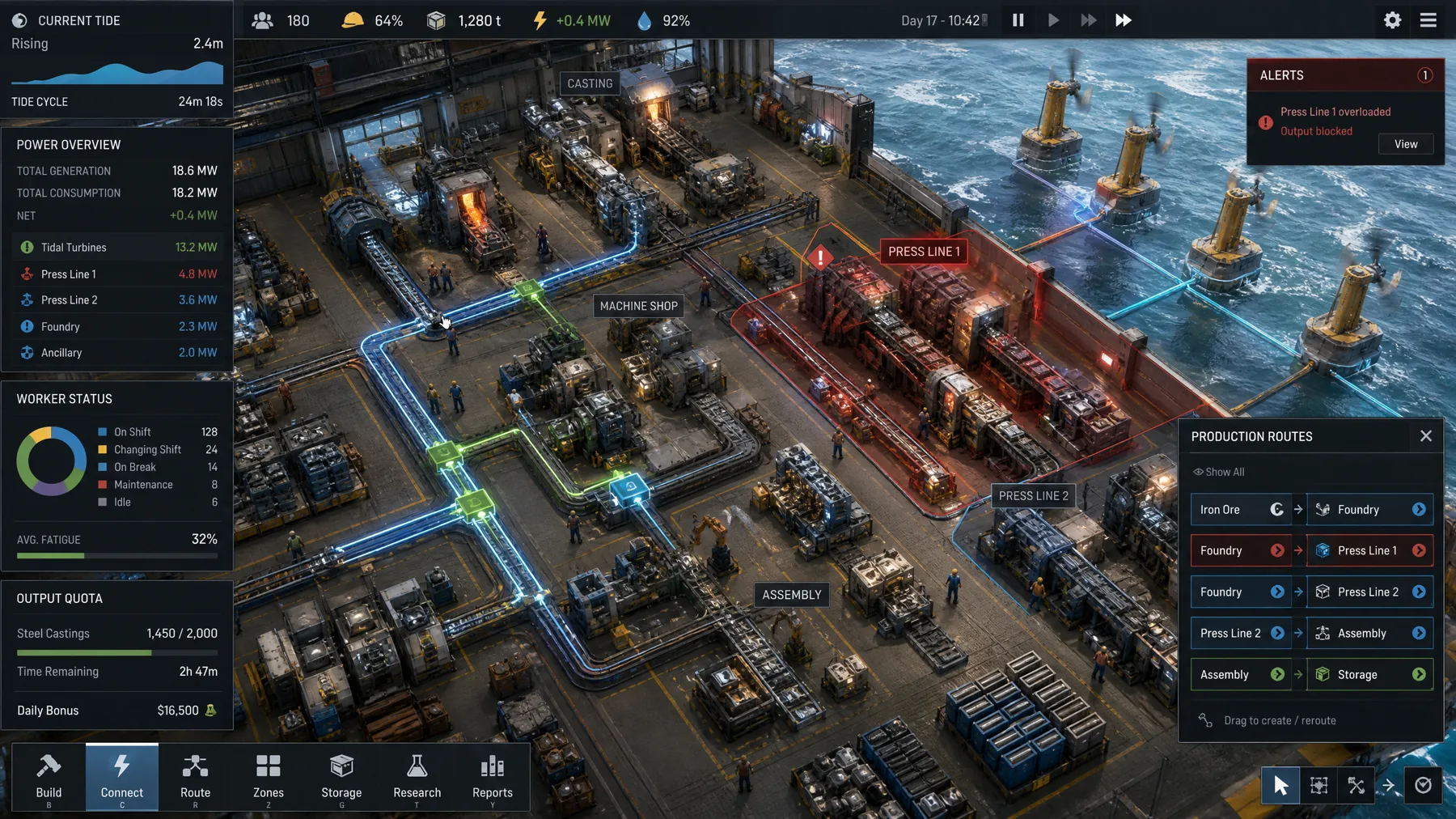
At first glance, the isometric view of the foundry presents a familiar tableau of conveyor belts, smelting furnaces, and assembly arms. However, the beating heart of your operation lies just offshore, where massive tidal turbines churn the ocean's energy into usable electricity. The visual representation of this is striking. A dedicated power-flow overlay reveals a pulsing network of conduits connecting the churning sea to your factory floor. When the tide is rushing in, the turbines spin furiously, flooding your grid with cheap, abundant power. This is the time for heavy industry: firing up the arc furnaces, running the massive stamping presses, and pushing your production lines to their absolute limits.
The Ebb and Flow of Industry
The core gameplay loop revolves entirely around this tide-driven power mechanic. Unlike traditional management games where electricity is a constant resource to be purchased or generated at a steady rate, Whitecap Foundry requires you to plan your operations around a fluctuating power curve. When the tide recedes, the turbines slow to a crawl, and your available wattage plummets. If you have not prepared for this lull, the consequences are immediate and severe. Machines grind to a halt, conveyor belts stutter, and partially finished goods clog the arteries of your factory.
This dynamic forces a fascinating approach to line balancing. You cannot simply build a monolithic, always-on production line. Instead, you must design modular systems that can be rapidly powered up or shut down based on the current tidal phase. During peak flow, you might have every machine roaring, but as the water recedes, you must selectively route power to essential systems while idling energy-hungry equipment. The visual feedback during these transitions is excellent. The production HUD clearly displays real-time energy deficits, while the machinery itself visibly struggles—an overloaded press might spark and shudder before tripping a breaker, demanding immediate attention.
Managing the Human Element
While the machinery is the muscle of your operation, the workers are its lifeblood, and Whitecap Foundry places a significant emphasis on managing human resources. The isometric perspective offers a clear view of workers changing shifts, moving between the factory floor and the coastal barracks. Worker fatigue is a critical mechanic that you must monitor closely. Operating heavy machinery during a frantic high-tide production sprint drains your employees' stamina rapidly. If you push them too hard without adequate rest breaks or properly timed shift changes, their efficiency drops, and the risk of catastrophic accidents skyrockets.
Safety is not merely a background statistic; it is a pressing operational concern. Exhausted workers are prone to making mistakes, which can lead to equipment damage or personal injury. Implementing safety protocols, ensuring adequate lighting, and maintaining a reasonable pace of work are essential for long-term success. Ignoring these factors in the pursuit of short-term gains will inevitably result in a crippled workforce and a factory floor littered with broken machinery.
Maintenance and Fulfillment
Keeping the factory running requires constant vigilance. Maintenance is a persistent challenge, exacerbated by the harsh coastal environment. Saltwater corrosion and the sheer physical stress of the manufacturing process mean that your equipment is constantly degrading. You must schedule regular downtime for repairs, which adds another layer of complexity to your tide-based planning. Taking a critical machine offline for maintenance during a high-tide power surge is a massive waste of potential, but delaying repairs until low tide might result in a catastrophic failure when you need the equipment most.
The ultimate goal of all this logistical juggling is to fulfill lucrative contracts. These contracts dictate what you need to produce, in what quantities, and within specific timeframes. Some contracts might require massive batches of simple components, perfect for a sustained high-tide run, while others demand intricate, multi-stage assemblies that require careful planning across several tidal cycles. The variety of contracts keeps the gameplay fresh, constantly challenging you to reconfigure your factory layout and optimise your power usage.
Interface, Performance, and Accessibility
Navigating the complexities of Whitecap Foundry is made significantly easier by a well-designed and intuitive interface. The production HUD is clean and informative, providing at-a-glance data on power generation, resource consumption, and worker status. The isometric camera can be freely rotated and zoomed, allowing you to inspect every detail of your bustling factory or pull back for a macro view of the entire coastal complex. The power-flow overlay is particularly impressive, turning the invisible network of electricity into a tangible, manageable resource.
On PC, the game's performance is generally solid, even when the factory reaches massive proportions. The visual details—the churning water around the turbines, the sparks flying from the overloaded press, the subtle lighting changes as shifts rotate—are all rendered smoothly. However, there are occasional frame rate dips during the most intense high-tide production runs, particularly when viewing the entire factory at maximum zoom. These stutters are minor and do not significantly impact the overall experience.
Accessibility is a strong point, with the developers including a robust suite of options. The most notable inclusion is a comprehensive set of colour-blind modes. Given that the power-flow overlay and production HUD rely heavily on colour-coded information to convey critical data, these options are essential. The game allows you to customise the colour palettes for various UI elements, ensuring that players with different types of colour vision deficiencies can easily distinguish between optimal power flow, dangerous overloads, and idle machinery.
Verdict
Whitecap Foundry is a standout entry in the factory management genre. By tethering its core mechanics to the natural ebb and flow of the tides, it introduces a level of dynamic planning that is often missing from similar titles. The interplay between power generation, line balancing, and worker fatigue creates a rich, multi-layered puzzle that is both demanding and highly rewarding. While minor performance hiccups occasionally disrupt the flow, the overall experience is polished, engaging, and undeniably unique. It is a game that requires you to think not just about what you are building, but when and how you are building it, making every successful production run feel like a hard-won victory against the elements.
| Category | Assessment |
|---|---|
| Gameplay | Innovative tide-driven mechanics demand dynamic planning and constant adaptation. |
| Visuals | Detailed isometric art with excellent visual feedback for power flow and machinery status. |
| Performance | Mostly stable, though minor frame rate dips occur during peak production phases. |
| Accessibility | Excellent colour-blind options ensure critical UI elements remain legible for all players. |
| Overall Score | 8.6 / 10 |