
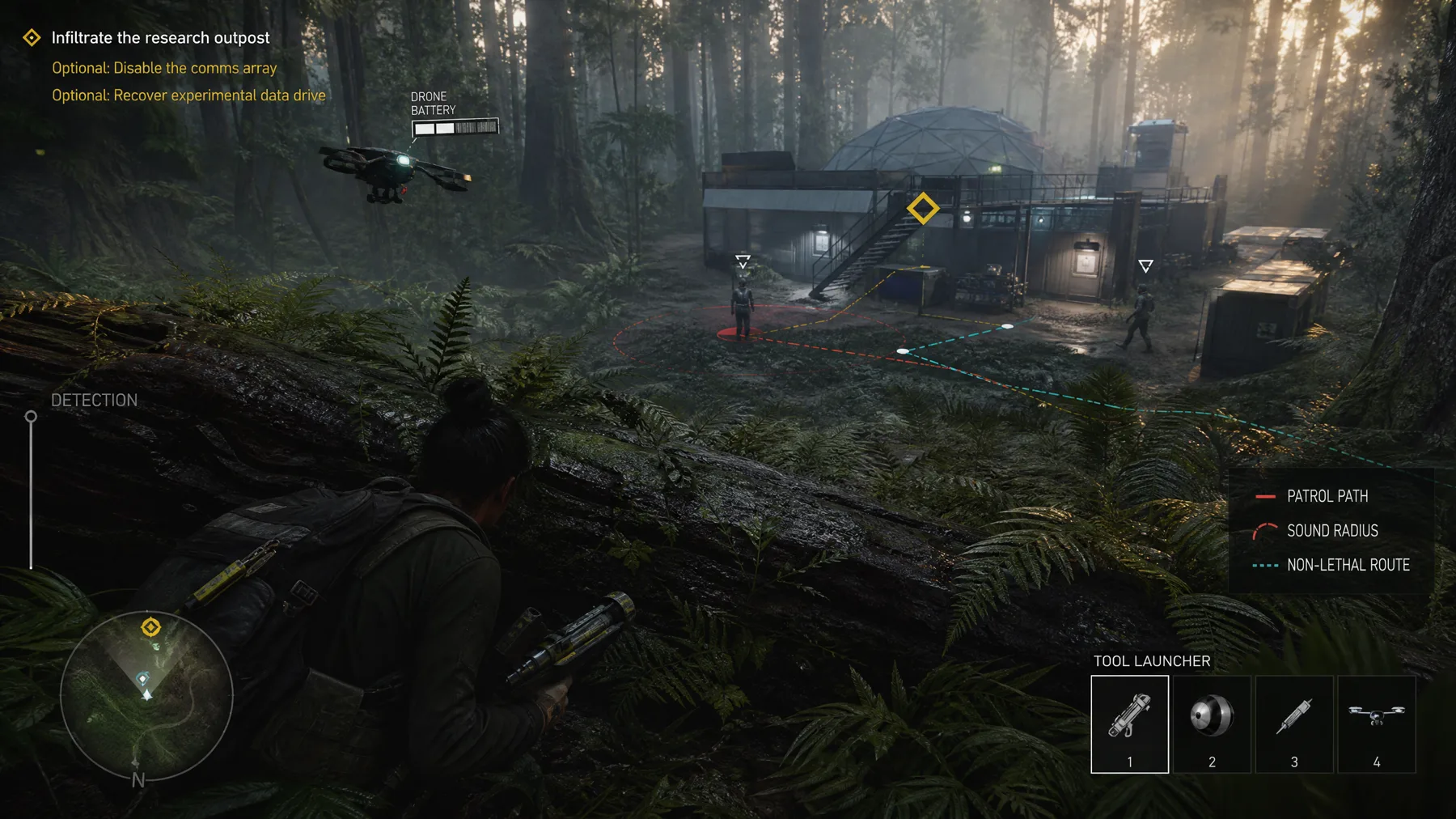
There is a specific tension that defines the best moments in Kauri Breakpoint. You find yourself crouched behind a moss-draped kauri log, the damp forest floor beneath your boots, peering through the dense New Zealand bush at a fortified outpost. In these quiet, calculated seconds before action is taken, the game truly shines. Kauri Breakpoint is a third-person stealth experience demanding patience, observation, and a deep understanding of your environment. Released on PC and PlayStation 5, it strips away the run-and-gun safety nets of its contemporaries, forcing players to rely on their wits, a battery-limited drone, and a meticulous understanding of enemy patrol paths.
The Observation Loop and the Battery-Limited Drone
At the heart of Kauri Breakpoint is an incredibly satisfying observation loop. Before setting foot inside an enemy encampment, you must scout. This is where your primary gadget, a compact reconnaissance drone, comes into play. Launching the drone from behind the safety of your kauri log allows you to get a bird's-eye view of the outpost, tagging hostiles and mapping out patrol paths. However, the developers smartly implemented a strict battery limit. You cannot hover indefinitely, marking every guard at your leisure. The battery drains quickly, especially if you use advanced thermal imaging or zoom functions.
This limitation fundamentally changes how you approach each encounter. You must prioritise your scouting targets. Do you focus on the snipers positioned on the watchtowers, or do you track the heavily armoured patrols walking the perimeter? The drone's battery forces a risk-reward dynamic; you might have to recall it early to let it recharge, leaving a blind spot in your mental map, or risk losing it entirely. This mechanic ensures the observation phase is an active, tense part of the gameplay. When you finally make your move, you are relying on a combination of your drone's incomplete data and your own spatial awareness.
Sound Propagation and the Tool Launcher
Once you transition to infiltration, Kauri Breakpoint introduces its most impressive technical achievement: a sophisticated sound propagation system. Every action generates a visual sound arc on your HUD, indicating exactly how far the noise will travel. Stepping on a dry ponga frond, splashing through a muddy creek, or reloading your weapon too aggressively creates distinct sound profiles that enemies will investigate. The environment is a dynamic element you must constantly negotiate. Dense foliage can muffle footsteps, while corrugated iron rooftops will amplify them, turning a stealthy approach into a chaotic scramble.
To manipulate this soundscape, you are equipped with a versatile tool launcher. This is not a weapon for direct confrontation, but an instrument of misdirection. You can fire acoustic decoys to draw guards away from a chokepoint, deploy EMP darts to disable security cameras, or shoot non-lethal smoke canisters to create temporary visual cover. The tool launcher operates on a physics-based trajectory system, requiring you to account for drop and wind resistance. Mastering it is essential for executing the game's demanding non-lethal routes, allowing you to orchestrate complex distractions and slip past patrols without raising an alarm.
Non-Lethal Scoring and Forgiving Checkpoints
Kauri Breakpoint actively encourages and rewards a pacifist approach. At the end of each mission, you are graded on a comprehensive scoring system that heavily favours non-lethal takedowns and complete ghost runs. The game tracks your every move, deducting points for lethal kills, triggered alarms, and leaving unconscious bodies in plain sight. This scoring system transforms the game into a high-stakes puzzle. Finding the optimal non-lethal route through an outpost—perhaps by exploiting a gap in the patrol paths you identified earlier—is immensely satisfying and offers substantial replay value.
Despite its demanding mechanics, the game is respectful of the player's time, thanks to an intelligent checkpoint system. Instead of forcing you to replay an entire twenty-minute infiltration because of a single misstep, Kauri Breakpoint frequently auto-saves your progress after you clear a significant section of an outpost or secure a major objective. This pacing alleviates the frustration often associated with hardcore stealth games. It encourages experimentation, allowing you to try a risky maneuver with the tool launcher, knowing that failure will only set you back a minute or two.
Controller Feel and Haptic Feedback
The tactile experience of playing Kauri Breakpoint is superb, particularly on the PlayStation 5. The DualSense controller is utilised to brilliant effect, providing nuanced haptic feedback that enhances the stealth immersion. When crouched in the undergrowth, you can feel the subtle heartbeat of your character pulsing through the grips, a tempo that increases when an enemy patrol walks near your hiding spot. The adaptive triggers offer distinct resistance when firing the tool launcher, simulating the tension of a high-pressure pneumatic system.
On PC, the game offers robust controller support and fully customisable keyboard and mouse bindings. The mouse aiming for the tool launcher is predictably precise, allowing for pinpoint accuracy when firing decoys through narrow gaps. However, the analogue movement afforded by a controller feels more natural for a stealth game, allowing you to carefully modulate your walking speed to minimise your sound arcs. Regardless of your chosen input method, the character movement feels weighty and deliberate, grounding you in the world and making every step feel consequential.
Accessibility and Technical Performance
The development team has made commendable strides in accessibility, ensuring that the demanding stealth mechanics can be enjoyed by a wide audience. The options menu is extensive, offering granular control over the game's difficulty and interface.
- Visual Cues: Players can toggle high-contrast modes for enemies and interactive objects, making them easier to spot against the dense forest backgrounds.
- Audio Visualisation: The sound arcs can be adjusted in size and colour, and a directional threat indicator can be enabled for players who are deaf or hard of hearing.
- Motor Accessibility: The game includes options to change hold actions to toggles, rebind all controls, and adjust the aim assist strength for the tool launcher.
From a technical standpoint, Kauri Breakpoint performs admirably. On the PlayStation 5, the game offers a fidelity mode, prioritising 4K resolution and lush textures, and a performance mode targeting a smooth 60 frames per second. Given the precision required for stealth, the performance mode is highly recommended. On PC, the game is well-optimised, scaling beautifully across hardware. Even on mid-range systems, it maintains a stable framerate, ensuring a sudden stutter will not cause a failed infiltration. The lighting engine is particularly noteworthy, casting realistic, dynamic shadows through the kauri canopy that are essential for hiding from enemy patrols.
Verdict
"A masterclass in tension and observation, demanding patience and rewarding intelligence."
Kauri Breakpoint is a triumph of the stealth genre. It understands that the thrill of infiltration comes not from action, but from the anticipation of it. By forcing players to rely on their observation skills, manage a battery-limited drone, and carefully navigate complex sound propagation systems, the game delivers an experience that is both intellectually stimulating and incredibly tense. The emphasis on non-lethal routes and the forgiving checkpoint system create a loop that is addictive rather than frustrating. Those who appreciate the methodical, puzzle-like nature of true stealth will find a deeply rewarding experience waiting for them in the New Zealand bush. It is a brilliant, focused title that earns its 8.5 score through meticulous design and flawless execution.