
There is a distinct dread that accompanies the groaning of metal under immense oceanic pressure. In Deep Current Station, a four-player cooperative repair game on PC and Xbox Series consoles, that sound is your constant companion. It is a masterclass in tension, demanding flawless teamwork and rapid problem-solving as you attempt to patch up a deteriorating underwater facility before the crushing depths claim it entirely. Earning an impressive 8.8 out of 10, this title proves that cooperative gameplay can be as punishingly stressful as it is profoundly rewarding.
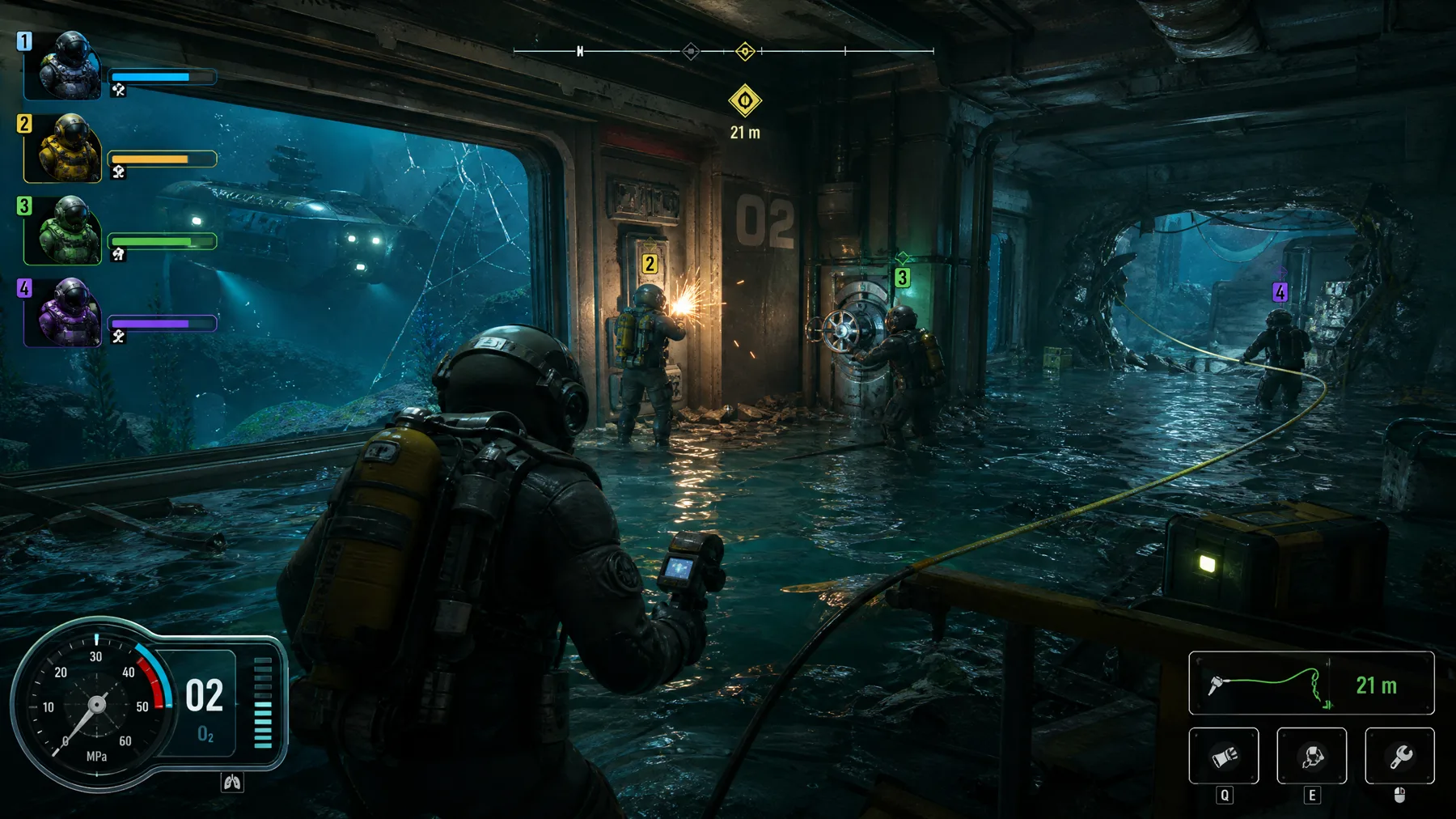
The core loop places you and up to three mates in the reinforced suits of deep-sea engineers. Your workplace is a failing underwater base where every cracked viewport and sparking electrical panel is a potential death sentence. The atmosphere is thick with dread, captured perfectly when your team is huddled inside a partially flooded corridor, desperately sealing a heavy bulkhead door while the water level steadily rises. You can almost feel the physical weight of the ocean bearing down as one player works the manual override, another stabilises the room's atmospheric pressure, and a third carefully routes a vital lifeline tether through the wreckage. Meanwhile, the game's uncluttered HUD feeds you a constant stream of critical data: your team's vital status, the fluctuating room pressure, dwindling oxygen reserves, and a ticking checklist of immediate objectives.
The Mechanics of Survival
What sets Deep Current Station apart from other cooperative panic-simulators is its profound emphasis on dynamic role switching. You are not locked into a specific class. Instead, the tools required for survival—welding torches, heavy wrenches, sealant dispensers, and diagnostic tablets—are physical objects that must be passed around, dropped, and retrieved. When a pipe bursts in the engine room, the player closest to the sealant needs to become the patcher, regardless of what they were doing a moment prior. This fluid approach to responsibility means that every player must intimately understand every system in the station. It prevents the common cooperative pitfall where one player is relegated to a boring task while the others have all the fun. Here, everyone is equally vital, and everyone is equally likely to cause a catastrophic failure if they lose focus.
Communication is naturally paramount, but the developers have implemented a robust, voice-free ping system that is nothing short of brilliant. While shouting over voice chat is an option, the contextual ping system allows for precise, non-verbal coordination. A single button press can highlight a ruptured pipe with a request for a welder, mark a safe path through a debris-filled room, or frantically alert the team to a sudden drop in oxygen. It is nuanced enough that a well-practised team can clear entire sectors in near-complete silence.
Pressure and Tethers
The environmental hazards are deeply integrated into the gameplay loop through a robust pressure simulation system. Water does not simply fill a room; it surges with physical force, pushing players around, obscuring vision, and altering the buoyancy of objects. Opening a door to a flooded compartment without first equalising the pressure will result in a violent blowout, potentially sweeping players away or slamming them into hazards. Managing the station's complex network of pumps, valves, and airlocks is a puzzle in itself, requiring players to constantly monitor the pressure differentials between adjacent zones.
Equally critical to your survival is the tether navigation system. In the darkest, most dangerous sections of the station, players must physically link themselves to a central oxygen and power hub via thick cables. These tethers are lifelines, but they are also massive liabilities. They can snag on debris, wrap around pillars, and become hopelessly tangled if players cross paths too often. Managing your tether—ensuring it has enough slack, keeping it clear of hazards, and untangling it when things go wrong—is a constant stressor that brilliantly simulates the claustrophobic reality of deep-sea diving. If a tether is severed, the attached player has only seconds of internal oxygen remaining to find a spare tank or rush back to the airlock.
"The tether system transforms simple movement into a deliberate, cooperative puzzle. You are not just walking; you are managing a physical lifeline that binds the team together."
Emergent Disasters and Solo Play
The pacing of Deep Current Station is driven by its emergent failures. While you have a set list of objectives to complete in each sector, the station is constantly degrading around you. A routine electrical repair might be interrupted by a sudden hull breach in the adjacent room, forcing the team to drop their tools and scramble for the bulkhead doors. These random events ensure that no two playthroughs are ever exactly alike. The AI director controlling the station's decay is ruthless but fair, generally ramping up the pressure just as the team starts to feel comfortable.
For those who prefer to brave the depths alone, the game features a surprisingly competent system of solo bots. These AI companions are not capable of complex problem solving on their own, but they are excellent at following orders. Using the ping system, a solo player can direct bots to hold doors, operate pumps, or carry heavy equipment. They are reliable and obedient, though they lack the creative panic of human teammates. While the game is undeniably at its best with a full crew of human players, the solo experience is entirely viable and offers a different, more methodical challenge.
Performance and Accessibility
From a technical standpoint, the game performs admirably across both PC and Xbox Series consoles. The water physics and dynamic lighting are visually stunning, accurately capturing the murky, oppressive atmosphere of the deep ocean. Framerates remain stable even during the most chaotic moments, which is crucial when split-second timing is required to seal a door or catch a tossed tool. The audio design deserves special mention; the groaning metal, the rush of water, and the muffled thumps of distant explosions provide critical auditory cues about the station's structural integrity.
Accessibility has clearly been a priority for the development team. Beyond the excellent voice-free ping system, the game offers a wealth of options to tailor the experience. Colourblind modes are comprehensive, ensuring that critical HUD elements and environmental warnings are clearly distinguishable. There are options to toggle hold-to-press interactions, adjust the size and contrast of subtitles, and heavily customise the control scheme.
Verdict
Deep Current Station is a triumphant entry into the cooperative gaming space. It takes the frantic, task-management gameplay of the genre and submerges it in a terrifying, highly atmospheric setting. The mechanics of role switching, pressure management, and tether navigation are interwoven brilliantly, creating a gameplay loop that is constantly engaging and frequently terrifying. While the difficulty curve can be steep, and the emergent failures occasionally feel a bit too punishing, the sense of accomplishment when your team successfully stabilises a collapsing sector is unmatched. Earning a well-deserved 8.8, it is a game that demands your full attention, your best communication skills, and perhaps a spare oxygen tank. It proves that down in the crushing dark, your greatest asset is the team tethered to your side.