
Wellington's Concrete Canopy Awaits
The Cook Strait southerly isn't just a weather event in Skyhook Wellington; it's an active participant in your momentum. Dangling fifty metres above the rain-slicked asphalt of Lambton Quay, the tension in your grappling cable sings a high-pitched metallic whine as a sudden gust catches you mid-swing. You have half a second to adjust your trajectory, factoring in the crosswind, your remaining stamina, and the rapidly approaching glass facade of a high-rise office block. This first-person traversal game, currently in an impressive early build for PC and PS5, transforms the New Zealand capital into an intricate, vertical playground where gravity and gale-force winds are both your greatest adversaries and your most valuable tools.
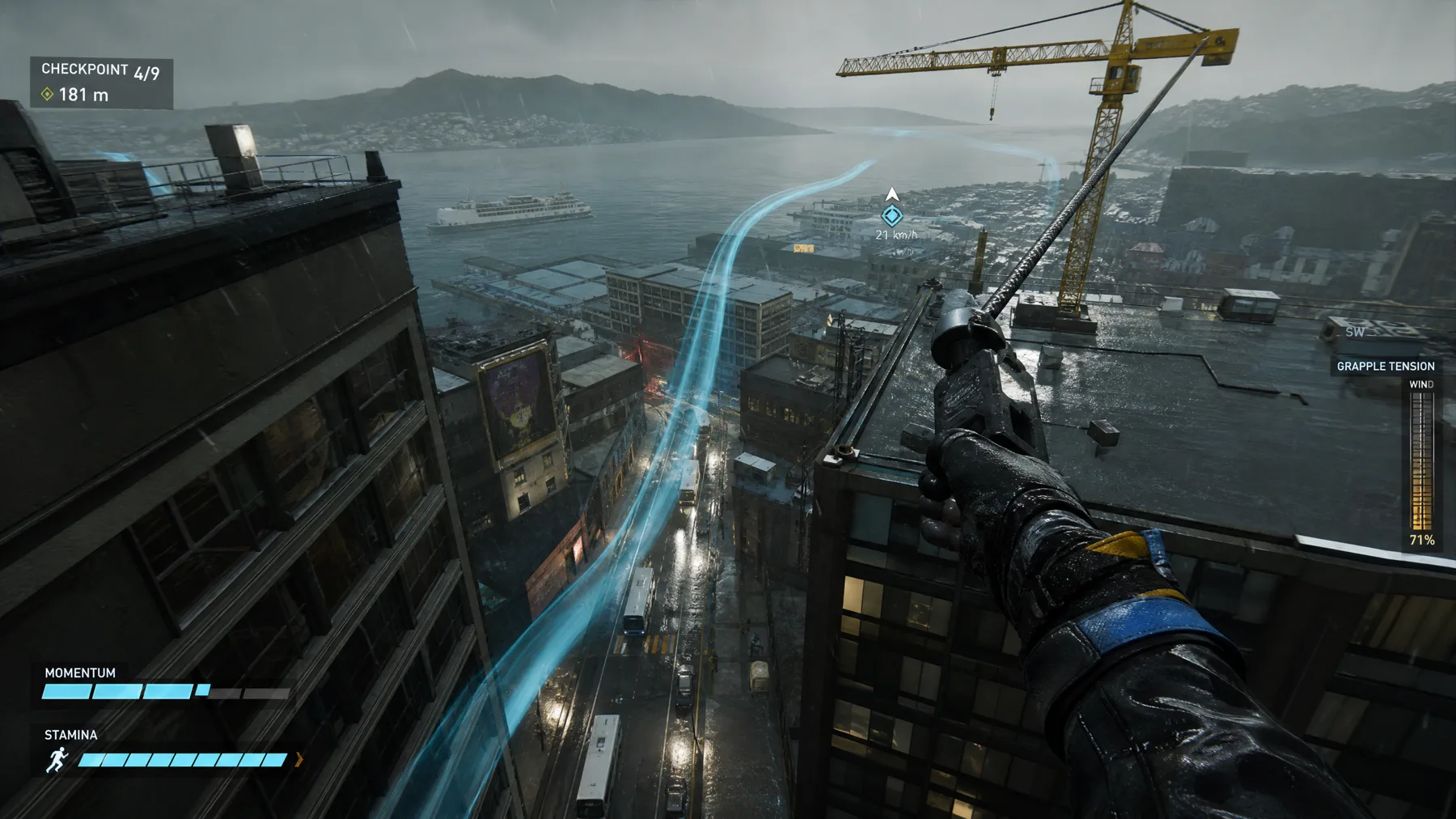
The core of Skyhook Wellington revolves around an incredibly satisfying, physics-driven grappling mechanic. Unlike many traversal games where a hookshot pulls you in a straight, frictionless line towards a target, the system here demands a profound understanding of pendular motion and cable tension. When you fire your dual wrist-mounted grapples at the corrugated iron roof of a colonial villa or the steel girders of a modern skyscraper, you don't just zip there. You swing, you arc, and you must manually release at the precise apex of your momentum to launch yourself forward. The HUD is a masterpiece of minimalist design, displaying your cable tension as a subtle colour gradient on the reticle, while a curved stamina bar dictates how long you can hold on before your grip fails and you plummet toward the harbour city below.
Riding the Wind Lanes
What elevates the traversal from a mere physics toy to a brilliant piece of environmental puzzle-solving is the implementation of 'wind lanes'. Wellington is famously windy, and the developers have weaponised this meteorological quirk. Invisible rivers of air rush between the city's towers, visualised on your HUD as faint, flowing contrails when you activate your tactical visor. Catching a tailwind in one of these lanes can double your swing speed, allowing you to clear massive gaps that would otherwise be impossible. Conversely, fighting a headwind drains your stamina exponentially faster and severely truncates your arc. It forces a constant calculus. Do you take the direct route and fight the gale, or do you detour through a sheltered alleyway, using wall-runs and short-range grapples to conserve energy?
This dynamic environment makes route improvisation the beating heart of the experience. While the game features structured time trials that demand route memorisation and flawless execution, the sheer joy of the free-roam mode lies in chaining together spontaneous movements. You might intend to reach the Beehive via the waterfront, but a sudden shift in the wind direction forces you to divert through the CBD, improvising a path across wet rooftops and construction cranes. The game rewards flow state above all else. Stringing together a flawless sequence of swings, wall-runs, and wind-assisted glides feels intoxicating.
The Price of Gravity
Of course, what goes up must occasionally come down, and Skyhook Wellington is unapologetic about the consequences of failure. Falls are terrifyingly visceral in first-person, the wind roaring in your ears as the pavement rushes up to meet you. However, the checkpoint system is remarkably forgiving during the main campaign missions. If you miss a grapple or misjudge a wind lane, the game swiftly rewinds you to the last stable surface you touched, subtracting a few seconds from your overall time rather than forcing a tedious reload. In the dedicated time trials, however, the gloves come off. A single mistake often means a complete restart, demanding absolute perfection for those chasing the gold medals and top spots on the global leaderboards.
Control and Comfort
Translating such complex, high-speed movement to a control scheme is a monumental task, but the developers have largely succeeded. On the PS5's DualSense controller, the haptic feedback is nothing short of revelatory. You can feel the distinct tension of the left and right cables in the respective triggers, the resistance increasing as you reach the apex of a swing. The subtle vibrations communicate the rush of the wind lanes and the harsh impact of a clumsy landing. On PC, the mouse and keyboard setup offers unparalleled precision for targeting grapple points, though it lacks the tactile feedback that makes the controller experience so immersive. Both input methods feel tight and responsive, which is crucial when your survival depends on millisecond timing.
Given the intense, first-person acrobatics, motion sickness is a valid concern. Fortunately, the accessibility menu is robust. Players can toggle a persistent central reticle, adjust the field of view up to a generous 110 degrees, and enable a subtle vignette effect that darkens the edges of the screen during high-speed swings to reduce peripheral motion. You can even adjust the intensity of the camera bob and the wind-shear visual effects. These thoughtful additions ensure that the exhilarating traversal remains comfortable for a wide range of players, mitigating the nausea that often accompanies this genre.
A Harbour City Realised
Visually, the game captures the essence of Wellington with striking fidelity, even in this early build. The dynamic weather system is particularly impressive. A sunny afternoon can quickly give way to a torrential downpour, making the rooftops slick and altering the friction of your wall-runs. However, the current build is not without its limitations. Pop-in is occasionally noticeable when moving at terminal velocity, and some of the pedestrian models at street level lack the detail of the towering structures above. Performance on the PS5 targets a smooth 60 frames per second, which it mostly maintains, though intense weather effects can cause minor dips.
The Verdict
Skyhook Wellington is shaping up to be a premier traversal experience. It takes the fundamental joy of swinging through a city and elevates it with demanding physics, dynamic weather integration, and a deep respect for player skill and improvisation. While the early build exhibits some minor technical rough edges and the learning curve for the momentum mechanics is undeniably steep, the sheer exhilaration of mastering the wind and the wire is unparalleled. It is a game that demands your full attention, rewarding precision and daring in equal measure.
| Feature | Details |
|---|---|
| Core Mechanic | Physics-driven dual grappling with pendular momentum |
| Environment | Dynamic weather, wind lanes, wet harbour-city rooftops |
| Controls | Excellent DualSense haptics; precise mouse/keyboard targeting |
| Accessibility | FOV slider, vignette options, camera bob toggles |
| Current Score | 8.4 / 10 |